- Inicio
- Ecosistema AECO
- _ATLAS AECO
- __Mapa Global Obras
- __Serie Const. Vanguardistas
- _Estudios de Arquitectura
- __en Madrid
- __en Barcelona
- _Estudios de Ingeniería
- __en Madrid
- _Estudios de Interiorismo
- __en Madrid
- _Empresas Constructoras
- __en Madrid
- __en Barcelona
- _Empresas de Reformas
- __en Madrid
- _Empresas AECO
- __Fabricantes en España
- _Empresas de Modelado BIM
- __En España
- _Biblioteca Técnica AECO
- __Glosario AECO Global
- __Glosario de Construcción
- __Glosario de Edificación
- __Glosario BIM GTB-300
- __Edificación Circular
- _Entrevistas AECO
- __Jaime Sánchez-Álvarez
- _Visibilidad B2B y Partners AECO
- Arquitectura
- _RASCACIELOS
- __Burj Khalifa Dubai
- __Edificio Chrysler, NY
- _Estilos Arquitectónicos
- __Arquitectura Posmoderna
- __Deconstructivismo
- __Arquitectura High Tech
- Arte
- _Arte Universal
- _Arte Contemporáneo
- __Serge Marshennikov
- __Damian Lechoszest
- __John Kacere
- _Escultura
- __El Ángel del Norte
- __La Musa Dormida
- __Venus de Milo
- __Moisés de Miguel Ángel
- __Baldaquino de San Pedro
- __El rapto de Proserpina
- __La Verdad Velada
- __Perseo con cabeza de Medusa
- __Venus de Willendorf
- _Pintura
- __Capilla Sixtina
- __Cuadros Famosos
- __La Creación de Adán
- __Venus del Espejo Velázquez
- __Hipómenes y Atalanta
- __Venus Boticelli
- __Silla de van Gogh
- __Jugadores de Cartas Cézanne
- __Cabeza de Medusa Caravaggio
- __Impresionismo
- __Posimpresionismo
- _Historia
- __Edad Moderna
- Curiosidades
- _Arquitectura y Arte
- _Tumba de Miguel Ángel
- FRASES
- _Frases de la semana
- _Arquitectos
- __Frank Gehry
- _Escultores
- __Miguel Ángel Buonarroti
- __Bernini
- __Rodin
- _Pintores
- __Picasso
- __Vincent van Gogh
- __Cézanne
- __Claude Monet
- __Henri Matisse
- __René Magritte
- __Caravaggio
- __Miguel Ángel
- Formación AECO
- _Másteres en España
- __Másteres BIM en España
- __Másteres de Arquitectura
- __Másteres de Ingeniería
- __Másteres de Construcción
- __Másteres en Interiorismo
- __Másteres Inmobiliarios
- __Máster Facility Management
- __Másteres de Smart Building
- __Máster Energía y Edificación
- __Máster en Infraestructuras
- __Másteres en Urbanismo
- __M. Project Management
- __M. Construcción Sostenible
- __M. Instalaciones MEP
- _Cursos BIM
- __Cursos BIM Online
- __Cursos Revit Online
- __Cursos Revit MEP online
- _Partner de Formación AECO
- _Formación AECO Empresas
- __en España
- __Capacitación en México
- __en Colombia


Arquitectura, Escultura, Pintura, Ingeniería, Software-Programas de Diseño Arquitectónico: Metodología BIM, Revit, AutoCAD, 3ds max, Animación; Software de Adobe; Cursos online, Libros, Historia, Cultura, Timelapse y Dronelapse sobre Arquitectura y ciudades, Frases Célebres, Curiosidades, Rascacielos, Puentes, Edificios interesantes, Construcciones vanguardistas, Construcciones famosas, Diseño, Arte, Fotografía Arquitectónica / Architecture, Sculpture, Painting, Engineering, Software-Architectural Design Programs: BIM Methodology, Revit, AutoCAD, 3ds max, Animation; Adobe software; Online courses, Books, History, Culture, Timelapse and Dronelapse on Architecture and cities, Famous Phrases, Curiosities, Skyscrapers, Bridges, Interesting buildings, Avant-garde constructions, Famous constructions, Design, Art, Architectural Photography

BP Pedestrian Bridge: Chicago’s Sculptural Steel Serpent

Series: Avant-Garde Constructions
Masterpieces of Architecture and Engineering: #14 BP Bridge, Chicago
Is it possible for a structure to act simultaneously as a walkway, a sculpture, and an acoustic shield?
The BP Pedestrian Bridge (1999-2004) represents one of the most unique engineering challenges in Chicago’s Millennium Park. Beyond its deconstructivist aesthetic, the work functions as a hybrid infrastructure that simultaneously resolves urban connectivity and acoustic insulation. It is the intersection between a curved reinforced concrete box girder and a sculptural steel envelope, becoming a true landmark for the city.

Simulating the sinuous movement of a snake, the Chicago BP Bridge shines thanks to its cladding made of 9,400 stainless steel panels with exquisite coloration.
« I wanted the bridge to look like something that flowed, almost like a snake crossing the road. I didn't want it to be a straight line; I wanted the walk to be an experience where the views changed as you moved through the curve. » — Frank O. Gehry
Typology and Structural System
Although the envelope suggests an organic lightness, the core of the bridge is a curved reinforced concrete box girder. This massive structure is supported by a series of circular reinforced concrete piers strategically placed along its total length of 282 meters.Span and Support: The design avoids suspension systems (cables or stays) to prevent interference with skyline views, relying on the girder's rigidity and the concrete's mass for stability.
Geometry: The ramp maintains a constant 5% slope, complying with universal accessibility standards (ADA) without breaking the sinuous movement of the layout.

« The bridge is, in essence, a large curved box girder. The challenge was to maintain aesthetic fluidity while ensuring the structural integrity of such a long span without resorting to traditional suspension systems. » — Stan Korista (SOM)
Envelope Engineering and Materiality
The "skin" of the bridge consists of 9,400 stainless steel panels with a brushed/vibrated finish, designed to create visual continuity with the adjacent Jay Pritzker Pavilion.
Visual Connection: The use of stainless steel creates material coherence with the neighboring stage.
Thermal and Light Management: Unlike a satin finish, the vibrated finish is non-directional, allowing for uniform light dispersion and preventing dangerous glare for road traffic. The interface between this metallic skin and the rigid core was one of the major technical challenges.
Walking Surface: The pedestrian deck extends over an average width of 6 meters, clad in treated natural hardwood slats.
« The bridge is a connector, but it's also a part of the pavilion's language. It's as if the metal had stretched out from the stage to invite people into the park. » — Frank O. Gehry
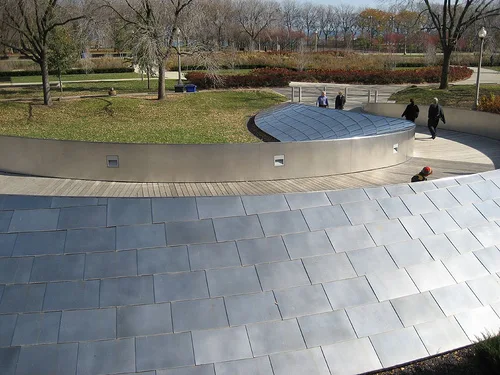
The Bridge as an Acoustic Shield
The sinuous morphology is not a formal whim, but an environmental engineering solution. The structure acts as a sound deflector to protect the pavilion's seating area from the traffic noise of Columbus Drive.Mass and Form: The combination of concrete mass and angled steel side walls creates an effective sound shield.
« We had the problem of noise from Columbus Avenue, which threatened the acoustics of the concerts. The bridge isn't curved for no reason; that curvature acts as a shield, deflecting the sound. » — Frank O. Gehry

Other Issues in the Series:
ISSUE #02 | CCTV Tower: Defying the Void
Beijing's most ambitious cantilever and the structural steel diagrid-grid that supports this continuous loop.
ISSUE #03 | Taipei 101: Dynamic Balance
Defying typhoons and earthquakes with the iconic 660-ton tuned mass damper.
ISSUE #04 | Hearst Tower: The NY Diamond
The efficiency of the Diagrid system: saving 20% of steel and redefining sustainability.
ISSUE #05 | Marqués de Riscal: Deconstructing Tradition
Frank Gehry’s parametric maturity: symbiosis between anodized titanium and 1860 heritage via aerospace software.
User Experience and Safety
Gehry’s design eliminates conventional handrails, integrating safety into the work's own volumetry through high walls that envelop the visitor.Immersion and Enclosure: The side walls are engineered to mitigate the vertigo effect while creating a sense of protection.
Integrated Lighting: The nighttime lighting system is concealed behind the side panels, emphasizing the sculptural nature of the steel without causing glare for pedestrians or drivers.
« By building the side walls so high and cladding them in steel, we created an interior space for the pedestrian. You are in the middle of Chicago, but the traffic noise disappears, and you're left with the sky and the shimmer of the metal. » — Frank O. Gehry

Project Model, featuring the BP Pedestrian Bridge in the foreground and the Jay Pritzker Pavilion in the background.
« The bridge’s concrete and steel deck were not designed just for pedestrians, but as a strategic acoustic barrier. The mass provided by the structural system is what protects the Pritzker Pavilion from traffic noise. » — Stan Korista (SOM)
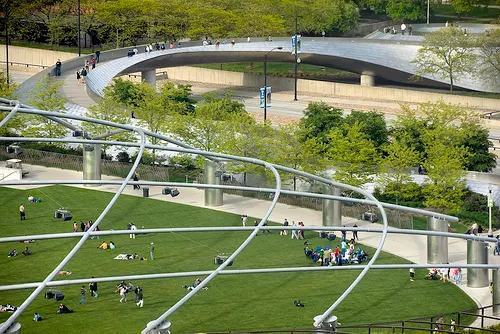
BP Pedestrian Bridge: Where Physics Becomes Urban Poetry
The BP Bridge, designed by the renowned architect Frank Gehry, is the ultimate reminder that avant-garde architecture is not the imposition of form over function, but a masterful negotiation between the two. In this bridge, Gehry’s sinuosity cannot survive without Korista’s structural discipline; the steel’s shimmer is not merely aesthetic but an acoustic shield; and the ramp is not just a path, but a gesture of universal inclusion. It is proof that when engineering dares to dream, infrastructure ceases to be a simple overpass and becomes a landmark for the city’s soul.
« Precision was paramount. Every plate and structural connection had to account for the thermal expansion of the stainless steel cladding against the concrete core. » — Stan Korista (SOM)
Industrial Specifications & Solutions
PROJECT PARTNERS| Component | Partner / Brand | Detailed Technical Execution |
|---|---|---|
| Architect of Record | SOM (Skidmore, Owings & Merrill) | Structural and regulatory development of Gehry Partners' conceptual design, ensuring building code compliance and structural safety factors. |
| 3D Parametric Modeling | Gehry Technologies | Advanced BIM and engineering consulting using Digital Project software (powered by CATIA) for precise 3D surface mapping and millimeter-level detailing of curved cladding panels. |
| Steel Cladding Skin | Permasteelisa Group | Detail engineering, fabrication, and building envelope assembly: featuring over 10,000 individual custom-shaped Grade 316 stainless steel architectural shingles. |
| Internal Structural Steel | Industrial Steel Construction | Detailing, heavy metal fabrication, and shop welding of the continuous helical structural steel box girder engineered to counteract complex torsional and bending stresses. |
| General Contractor | Walsh Construction Company | Execution of comprehensive site civil engineering, deep foundations, and high-precision rigging and erection of the structural steel segments spanning the roadway. |
| Lighting Design | L'Observatoire International | Architectural lighting concept utilizing concealed linear luminaires integrated beneath the handrails to highlight the steel contours while preventing glare. |
| Wood Decking / Paviment | Teak Decking Systems | Supply of premium, marine-grade solid teak wood battens engineered to naval standards to deliver underfoot comfort and extreme durability against freeze-thaw cycles. |
Are you the manufacturer, installer, or specifier for any of these systems?
Request your official partner link activation by contacting us at:
info@jmhdezhdez.com
Are you passionate about architecture and engineering that breaks the mold?
If the sculptural sinuosity of the BP Pedestrian Bridge has fascinated you, discover how other global skyline landmarks defy physics. In my works, I dissect through technical illustrations the mastery behind the most avant-garde structures on the planet.
Bilingual Technical Works / Obras Técnicas Bilingües


Frequently Asked Questions (FAQs) regarding the Chicago BP Bridge:
Why is it named the BP Pedestrian Bridge?
The name stems from a $5 million sponsorship by British Petroleum (BP). This funding was instrumental in executing Gehry’s geometric complexity and utilizing high-performance materials, such as 316 stainless steel, ensuring the project's feasibility without compromising technical quality.
How does such a long span maintain stability without suspension cables?
To preserve unobstructed skyline views, stays and cables were ruled out. Stability relies on a reinforced concrete box girder core designed by Stan Korista (SOM). Its significant depth and structural rigidity allow it to internally absorb the torsion and bending stresses generated by its sinuous layout.
How does the stainless steel respond to Chicago’s thermal oscillation?
The bridge utilizes 316 molybdenum-alloyed stainless steel, highly resistant to winter salt corrosion. The 9,400 panels function as a "floating skin" with expansion joints calculated to absorb thermal gradients between -20°C and 40°C, preventing metal expansion from fatiguing the concrete core.
What is the actual effectiveness of the bridge as an "acoustic barrier"?
It is a passive acoustic deflection system. The combination of the core’s mass and the sloped side walls acts by deflecting low-frequency noise from Columbus Drive traffic, thereby protecting the sound footprint and acoustic purity of concerts at the Jay Pritzker Pavilion.
What is the technical advantage of a vibrated finish over a satin finish?
The vibrated finish scatters light multidirectionally through a random pattern. This serves a dual purpose: road safety, by preventing direct reflections that could dazzle drivers on the avenue below, and constructive aesthetics, by concealing imperfections from the manual curving of the plates.
AECO Architecture & Engineering Glossary | BP Pedestrian Bridge, Chicago
Box Girder: A prismatic structural element with a hollow cross-section. Its closed design provides exceptional torsional rigidity, an indispensable quality to counteract the overturning moments and flexural-torsional forces generated by the bridge's curved, helical alignment without symmetrical intermediate supports.
Passive Acoustic Shielding: An environmental and operational engineering solution that mitigates noise pollution through massive physical barriers and dissipative geometry. By combining the density of the concrete core with inclined perimeter parapet walls, the structure redirects low-frequency noise originating from Columbus Drive traffic.
Non-Directional Vibrated Finish: A mechanical surface treatment applied to stainless steel sheets using a randomized micro-grinding pattern. It eliminates specular reflectivity and directional glare that could blind drivers on the lower roadway, distributing light in a diffuse manner.
Grade 316 Stainless Steel: An austenitic steel alloy featuring chromium, nickel, and fundamentally, between 2% and 3% molybdenum. This chemical addition drastically enhances resistance to environmental pitting corrosion and chloride attack, which is essential to withstand Chicago's winter climate and heavy de-icing salt use.
Thermal Expansion Interface: A structural and construction joint detail engineered to absorb differential movements between two materials with disparate coefficients of thermal expansion. It regulates the deformation of the floating stainless steel skin relative to the rigid concrete core under extreme temperature gradients (-20°C to 40°C).
Advanced Parametric Design: A digital modeling methodology driven by algorithms that define the geometric relationships of design elements. Using Digital Project software (powered by the CATIA engine), the bridge's organic envelope was analytically broken down for three-dimensional mapping and custom fabrication of each shingle-like metal plate.
Constant Accessible Slope: A geometric design parameter for pedestrian pathways that limits the longitudinal inclination of the deck to comply with universal accessibility standards (ADA). Strictly fixed at 5%, it eliminates the need for intermediate landings or stepped ramps, preserving aesthetic fluidity.
Self-Supporting Span System: A structural typology configuration that relies entirely on the internal rigidity of its box girders and circular reinforced concrete piers for stability, discarding auxiliary suspension systems (such as cables or stay-rods) to keep the skyline's visual lines uninterrupted.
Series: Vanguard Buildings | jmhdezhdez.com

José Miguel Hernández Hernández
International authority in the technical analysis of iconic and sculptural architecture. Specialist in the intersection of engineering, aesthetics, and the avant-garde. Author of technical bilingual books Turning Torso – Santiago Calatrava and Famous Constructions / Construcciones Famosas.

Publicado por José Miguel


José Miguel Hernández Hernández
Consultor Smart Home y Movilidad Eléctrica AECO
Servicios Destacados
⚡ Consultoría Movilidad Eléctrica
Proyectos CICE e ITC-BT-52.
🎓 Formación BIM / AECO
Especialización técnica avanzada.
📩 Suscripción Nodo Maestro
Innovación y normativa Smart.


Ecosistemas Smart Home por Tipología Guías técnicas y selección de dispositivos para proyectos de arquitectura e interiorismo en Pisos, Lofts, Casas Grandes, Dúplex, Áticos y Villas de Lujo. Integra automatización adaptada a cada espacio.
Ver Guía por Tipologías →
Directorio de Fotógrafos de Arquitectura en España: Descubre a los Mejores Expertos en Fotografía Arquitectónica para Documentar tus Proyectos y Obras

Fotografía Arquitectónica: La Guía Definitiva para Capturar Diseño, Estética y Función de Edificios y Estructuras

Fotografía y Vídeo Timelapse

El Rol del Fotógrafo de Arquitectura

Cámaras Réflex y Objetivos Tilt-Shift para Fotografía de Arquitectura

Estilos Arquitectónicos Modernos: Un Viaje a Través de la Creatividad y la Innovación

ARQUITECTURA CARRERA: Descubre todas las Opciones de la Carrera en Arquitectura y Grados en España

Comparativa de las Mejores Universidades de Arquitectura del Mundo: Internacional, Europa, LATAM

Los Mejores Libros de Arquitectura para Arquitectos

Libros para Estudiar Arquitectura

Libros para Arquitectos Principiantes: Guías y Recursos Esenciales para Comenzar tu Carrera

Los Mejores Libros de Arquitectura para Estudiantes durante la Carrera

Era Digital de la Construcción: Innovaciones Tecnológicas en Arquitectura y Edificación

Comparativa de Los Mejores Ordenadores para Arquitectos en 2024

Las Mejores Laptops para Arquitectura en 2024

Los Mejores Ordenadores de Arquitectura para Estudiantes

Significado de: Términos Clave sobre Arquitectura, Ingeniería y Construcción

Arquitectos: Descubre el Mejor Directorio de Arquitectos que podrás encontrar en Internet (Sólo en AC)
Tipos de Arquitectura: Explorando Más Allá de los Diseños Convencionales

FRASES DE ARQUITECTOS

Roles Arquitectura y Construcción (Profesiones Arquitectura)

Certificaciones para Arquitectos: Avanzando en la Excelencia Profesional

Roles BIM más Demandados en la Industria de la Construcción y el Sector AECO

Software BIM para Proyectos de Arquitectura y Construcción

Tecnología BIM: Beneficios y Ventajas en el sector AECO: Arquitectura, Ingeniería, Construcción y Operaciones

Modelo BIM

Modelo MEP

BIM 3D 4D 5D 6D 7D

AECO: Sector Arquitectura, Ingeniería, Construcción y Operaciones

Avances Tecnológicos en la Industria de la Construcción

Normas Técnicas de Edificación
!Explora el Mejor Directorio de Construcción! 🚧 🏗️ 👷♂️ (Sólo en ArquitecturaCarreras.com)


www.jmhdezhdez.com
jmhdezhdez.com — Arquitectura, Ingeniería y Documentación Técnica AECO
