- Inicio
- Arquitectura
- _RASCACIELOS
- __Burj Khalifa Dubai
- __Edificio Chrysler, NY
- _Estilos Arquitectónicos
- __Arquitectura Posmoderna
- __Deconstructivismo
- __Arquitectura High Tech
- _Serie Const. Vanguardistas
- Arte
- _Arte Universal
- _Arte Contemporáneo
- __Serge Marshennikov
- __Damian Lechoszest
- __John Kacere
- _Escultura
- __El Ángel del Norte
- __La Musa Dormida
- __Venus de Milo
- __Moisés de Miguel Ángel
- __Baldaquino de San Pedro
- __El rapto de Proserpina
- __La Verdad Velada
- __Perseo con cabeza de Medusa
- __Venus de Willendorf
- _Pintura
- __Capilla Sixtina
- __Cuadros Famosos
- __La Creación de Adán
- __Venus del Espejo Velázquez
- __Hipómenes y Atalanta
- __Venus Boticelli
- __Silla de van Gogh
- __Jugadores de Cartas Cézanne
- __Cabeza de Medusa Caravaggio
- __Impresionismo
- __Posimpresionismo
- _Historia
- __Edad Moderna
- Curiosidades
- _Arquitectura y Arte
- _Tumba de Miguel Ángel
- FRASES
- _Frases de la semana
- _Arquitectos
- __Frank Gehry
- _Escultores
- __Miguel Ángel Buonarroti
- __Bernini
- __Rodin
- _Pintores
- __Picasso
- __Vincent van Gogh
- __Cézanne
- __Claude Monet
- __Henri Matisse
- __René Magritte
- __Caravaggio
- __Miguel Ángel
- CULTURA
- _Museos
- __Museo del Louvre
- Formación
- _Formación BIM Online
- _Cursos Domestika
- Más
- _ENTREVISTAS
- __Johannes Wesskmark
- __Nathan Zawaya





Arquitectura, Escultura, Pintura, Ingeniería, Software-Programas de Diseño Arquitectónico: Metodología BIM, Revit, AutoCAD, 3ds max, Animación; Software de Adobe; Cursos online, Libros, Historia, Cultura, Timelapse y Dronelapse sobre Arquitectura y ciudades, Frases Célebres, Curiosidades, Rascacielos, Puentes, Edificios interesantes, Construcciones vanguardistas, Construcciones famosas, Diseño, Arte, Fotografía Arquitectónica / Architecture, Sculpture, Painting, Engineering, Software-Architectural Design Programs: BIM Methodology, Revit, AutoCAD, 3ds max, Animation; Adobe software; Online courses, Books, History, Culture, Timelapse and Dronelapse on Architecture and cities, Famous Phrases, Curiosities, Skyscrapers, Bridges, Interesting buildings, Avant-garde constructions, Famous constructions, Design, Art, Architectural Photography

O-14 Tower, Dubai: The Habitable Sculpture Defying the Desert

Series: Avant-Garde Constructions
Masterpieces of Architecture and Engineering: #20 O-14 Tower, Dubai
Is it possible for a building to breathe and support itself through its own skin?
The O-14 Tower in Dubai represents a paradigm shift in skyscraper typology. Located in Business Bay, adjacent to Dubai Creek, this 22-story structure has established itself as a true icon of avant-garde architecture. With its unmistakable white skin of curved forms and facade perforations, the project by Reiser + Umemoto transcends the traditional office building to become a genuine habitable sculpture. Internationally recognized with the CTBUH Award for Excellence and the ACEC Diamond Award, the tower stands as a manifesto of technical efficiency.

Instead of a skin that simply hangs from a structure, here the skin is the structure. It is an exoskeleton that frees the building from the constraints of an internal column grid. — Jesse Reiser

Detail of the perimeter reinforcement for openings: To prevent cracking due to stress concentrations in the concrete, each perforation features steel reinforcement rings integrated into the exoskeleton's rebar cage.
The rebar density in the O-14 Tower is exceptional. To materialize this exoskeleton, 3,000 tons of reinforcing steel were utilized. While historic skyscrapers like New York's Empire State Building used vast amounts of structural steel profiles, the challenge here lies in the passive reinforcement: thousands of interlaced steel bars that must absorb the complex torsional stresses generated by the 1,326 facade openings.
From the Framed Tube to the Parametric Exoskeleton: Evolution of a Paradigm Shift

In the evolution of high-rise structural systems, the O-14 Tower can be understood as a radical reinterpretation of previous typologies. Compared to the diagrid of the Hearst Tower in New York—where a diagonal steel mesh makes the load flow visible—the O-14 translates that logic into concrete, turning the facade into a continuous perforated mass.
Rather than organizing resistance through perimeter frames or rigid cores, such as the systems developed by Fazlur Rahman Khan, here the rigidity is distributed through a parametric geometry that integrates structure, envelope, and climatic behavior into a single entity.
Inverted Tectonics: The Concrete Exoskeleton
The most characteristic and distinctive feature of this iconic 105.7-meter architectural height building is its structure. While most conventional towers rely on an oversized central core and internal pillars, the O-14 shifts the resistance to the perimeter through a perforated concrete exoskeleton. This reinforced concrete perimeter superstructure functions as a self-supporting rigid tube, fusing lateral load resistance with the thermal envelope, allowing the elimination of interior pillars through a parametric stress transfer mesh.
Podium level floor plan: Transition to the upper volume destined exclusively for open-plan office spaces, optimizing connectivity with parking levels and service cores.
We were seeking an architecture where beauty was the direct result of solving climate and structural load. — Nanako Umemoto
This reinforced concrete "super-structure" is organized in a diagonal grid whose efficiency is based on a continuous variation of openings. The logic is brilliant: material is added where necessary and removed where possible. This tectonic inversion relieves the core of lateral forces, allowing it to be minimized to support only vertical loads and services.
The thickness of 60 cm at its base is reduced to 40 cm from the third floor upwards. With no interior pillars (spanning up to 10 meters), tenants can distribute the interior space freely. For the foundation, a 1.2-meter deep ring transfer beam collects the exoskeleton's loads and redistributes them toward 15 strategic columns, supported by a pressure slab and deep piles in the Business Bay soil.

Parametric Precision and Construction Process
The complexity of its skin is astounding: a mesh with 1,326 openings of 5 different sizes. The design was an iterative process between Rhino and SAP2000 to ensure the network channeled lateral loads (wind) efficiently, functioning as a monolithic rigid tube that minimizes sway.
Typical mid-height floor plan: The perforated concrete exoskeleton design eliminates interior pillars, achieving fully open-plan surfaces inside the building.
To materialize this geometry, a slip-form system was used alongside high-density polystyrene blocks (pills) cut via CNC. These negative molds, surrounded by steel reinforcement rings, allowed for the pouring of 19,000 m³ of concrete, creating a facade that acts as a three-dimensional Vierendeel beam.

Section diagram illustrating the convection air flow between the double skin (perforated concrete exoskeleton and glass curtain wall, separated by one meter). This produces the chimney effect, acting as a passive cooling system that reduces direct solar radiation as a brise-soleil.
Passive Intelligence: The Chimney Effect
The O-14 utilizes a double facade: the exoskeleton and an inner curtain wall, separated by a one-meter air cavity. As the sun heats the concrete, hot air rises through convection. This chimney effect extracts heat before it penetrates the building, functioning as an intelligent solar shield that reduces energy consumption by 30%.
O-14 Shell Stress Diagram. Load transfer analysis: this stress mapping reveals how parametric geometry channels wind and gravity loads non-uniformly, allowing the facade to act as a high-efficiency monolithic rigid tube that completely frees the interior space.
Making a surface with over a thousand perforations behave as a stable load-bearing wall was one of the greatest challenges of my career. — Ysrael Seinuk
Other Issues in the Series:
ISSUE #01 | Burj Khalifa: The Wind Code
Stepping Technique: how geometric variation tames vortices at 828 meters.
ISSUE #02 | CCTV Tower: The Cantilever Challenge
The gravity-defying colossus: precision engineering and a critical dawn connection.
ISSUE #04 | Hearst Tower: The NY Diamond
Structural efficiency: Norman Foster's Diagrid system and steel savings.
ISSUE #15 | Media-TIC: The Digital 'La Pedrera'
Enric Ruiz-Geli & Cloud 9: Hybrid infrastructure, transfer mega-structure and intelligent ETFE skin.

Inhabited Sculpture: Where Art is Structural
The beauty of the O-14 Tower is not an aesthetic addition, but the result of its technical resolution. By eliminating the traditional curtain wall as the primary envelope, the tower is perceived as a solid perforated object—an urban-scale sculpture where the openings act as stress-relief points and windows into a new way of understanding space.
Awards at the Vanguard of Engineering
The relevance of the O-14 Tower lies not only in its aesthetics but in the global industry consensus on its structural and functional success. These accolades validate every dimension of the project:10-Year Award of Excellence (CTBUH): The most prestigious recognition from the CTBUH (Council on Tall Buildings and Urban Habitat). It does not reward novelty but long-term performance. It is proof that its exoskeleton and bioclimatic system have stood the test of time for 10 years with exceptional operational efficiency.
AIA NY Design Award: Granted by the American Institute of Architects, this award underscores compositional excellence. It validates the architects' ability to transform a structural necessity into an urban sculpture of high artistic value.
ACEC Diamond Award: The highest honor from the American Council of Engineering Companies. It is the "Nobel Prize" of civil engineering, recognizing the analytical complexity of its parametric mesh and the innovation of the self-supporting rigid tube system.
Concrete Industry Board (CIB) Award of Merit: An award for construction craftsmanship. It recognizes the technical feat of executing a concrete pour of such geometric complexity using CNC polystyrene molds, achieving millimeter precision on site.

The Manifesto of Structural Honesty: Where Form IS Function
The O-14 Tower does not just stand out in the Dubai skyline; it defies it. It is tangible proof that in avant-garde architecture and engineering, the old axiom has evolved: form no longer follows function—form IS function. By integrating structural strength and bioclimatic control into a single concrete calligraphic gesture, the building eliminates the superfluous to embrace radical technical efficiency. It is a work where structural honesty dictates the aesthetic, reminding us that the purest beauty is not that which is added, but that which emerges when the very engine of engineering becomes visible.
Frequently Asked Questions about Dubai’s O-14 Tower:
Why is the design considered a paradigm shift?
Because it breaks the hegemony of the glazed curtain wall. By shifting the structural load to the perimeter via its perforated skin, the building eliminates the need for internal columns, optimizing habitable space and redefining passive sustainability in extreme climates.
How exactly does its "Chimney Effect" work?
The exoskeleton and the inner curtain wall are separated by a one-meter air cavity. Through natural convection, hot air rises and is expelled at the top, creating a continuous current that keeps the inner skin significantly cooler than the outside temperature, reducing air conditioning consumption by 30%.
What is the logic and size behind the 1,326 facade openings?
It is not a random pattern, but a data-driven matrix featuring five standard perforation sizes. The parametric design dictated that smaller diameters concentrate at the base to provide more concrete section against loads, while larger ones are placed toward the top to reduce self-weight, achieving a total porosity of 45%. This figure is the exact balance found through parametric modeling to maintain structural stability against Persian Gulf winds; it is the "magic number" that allows the tower to be both solid and transparent simultaneously.
What structural challenge did such a perforated skin pose?
Ensuring that a surface with over a thousand perforations behaved as a stable load-bearing wall. This required a constant bidirectional data flow between Rhino (geometry) and SAP2000 (structural analysis) to model stress transfer at every point of the mesh.
What role did the polystyrene molds play on site?
High-density polystyrene blocks cut via CNC (referred to as pills) were used. These acted as the negative formwork within the slip-form system, allowing the concrete to be poured while creating exact voids with a clean, avant-garde finish.
How does such a heavy structure interact with the ground?
It utilizes a 1.2-meter thick ring transfer beam at the base. This beam collects the loads from the exoskeleton's 19,000 m³ of concrete and redistributes them toward 15 strategic columns supported by deep piles in Business Bay.
What freedom does this system offer for interior design?
By eliminating interior pillars and traditional dropped beams, clear spans of up to 10 meters are achieved. This provides total flexibility to distribute office spaces without visual or structural obstacles.
Credits and Bibliographic Sources
- Header Photography (Low-angle): © Sandra Draskovic, Architect.
- Planimetry, diagrams, and construction site photos: © RUR Architecture (Reiser + Umemoto).
- Technical diagrams and bioclimatic analysis: Based on the Case Study: O-14 by CTBUH (Council on Tall Buildings and Urban Habitat).
- Structural Analysis: Technical data consulted from Ysrael A. Seinuk, PC.

José Miguel Hernández Hernández
Global authority in the technical analysis of iconic and sculptural architecture. Specialist at the intersection of structural engineering, aesthetics, and avant-garde design. Author of the bilingual technical works Turning Torso – Santiago Calatrava and Famous Constructions.

Publicado por José Miguel


José Miguel Hernández Hernández
Consultor Smart Home y Movilidad Eléctrica AECO
Servicios Destacados
⚡ Consultoría Movilidad Eléctrica
Proyectos CICE e ITC-BT-52.
🎓 Formación BIM / AECO
Especialización técnica avanzada.
📩 Suscripción Nodo Maestro
Innovación y normativa Smart.


Arquitectura y Tecnología al servicio del diseño inteligente.
Esta guía esencial para Smart Homes te muestra cómo integrar dispositivos inteligentes en viviendas contemporáneas, mejorando el confort, la eficiencia energética y el diseño funcional. Ideal para arquitectos, interioristas y entusiastas del arte del habitar.
👉 Descubre la guía completa

Directorio de Fotógrafos de Arquitectura en España: Descubre a los Mejores Expertos en Fotografía Arquitectónica para Documentar tus Proyectos y Obras

Fotografía Arquitectónica: La Guía Definitiva para Capturar Diseño, Estética y Función de Edificios y Estructuras

Fotografía y Vídeo Timelapse

El Rol del Fotógrafo de Arquitectura

Cámaras Réflex y Objetivos Tilt-Shift para Fotografía de Arquitectura

Estilos Arquitectónicos Modernos: Un Viaje a Través de la Creatividad y la Innovación

ARQUITECTURA CARRERA: Descubre todas las Opciones de la Carrera en Arquitectura y Grados en España

Comparativa de las Mejores Universidades de Arquitectura del Mundo: Internacional, Europa, LATAM

Los Mejores Libros de Arquitectura para Arquitectos

Libros para Estudiar Arquitectura

Libros para Arquitectos Principiantes: Guías y Recursos Esenciales para Comenzar tu Carrera

Los Mejores Libros de Arquitectura para Estudiantes durante la Carrera

Era Digital de la Construcción: Innovaciones Tecnológicas en Arquitectura y Edificación

Comparativa de Los Mejores Ordenadores para Arquitectos en 2024

Las Mejores Laptops para Arquitectura en 2024

Los Mejores Ordenadores de Arquitectura para Estudiantes

Significado de: Términos Clave sobre Arquitectura, Ingeniería y Construcción

Arquitectos: Descubre el Mejor Directorio de Arquitectos que podrás encontrar en Internet (Sólo en AC)
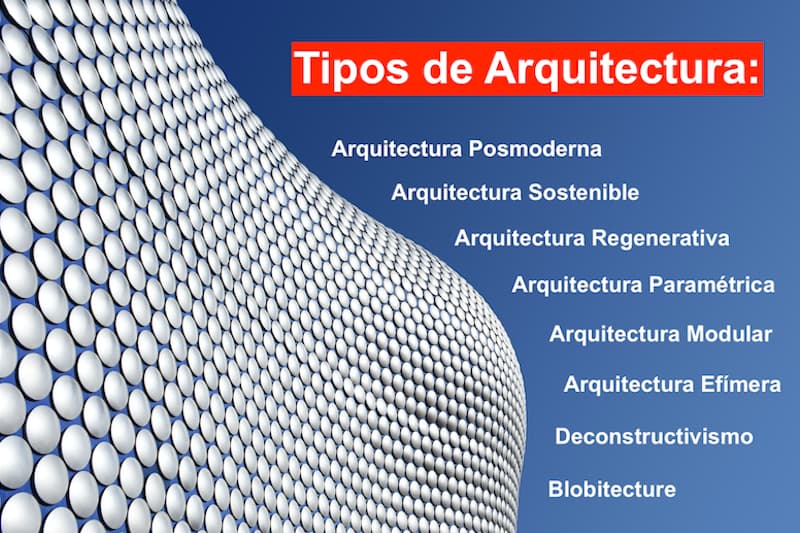
Tipos de Arquitectura: Explorando Más Allá de los Diseños Convencionales

FRASES DE ARQUITECTOS

Roles Arquitectura y Construcción (Profesiones Arquitectura)

Certificaciones para Arquitectos: Avanzando en la Excelencia Profesional

Roles BIM más Demandados en la Industria de la Construcción y el Sector AECO

Software BIM para Proyectos de Arquitectura y Construcción

Tecnología BIM: Beneficios y Ventajas en el sector AECO: Arquitectura, Ingeniería, Construcción y Operaciones

Modelo BIM

Modelo MEP

BIM 3D 4D 5D 6D 7D

AECO: Sector Arquitectura, Ingeniería, Construcción y Operaciones

Avances Tecnológicos en la Industria de la Construcción

Normas Técnicas de Edificación

!Explora el Mejor Directorio de Construcción! 🚧 🏗️ 👷♂️ (Sólo en ArquitecturaCarreras.com)


- CATEGORÍAS DE CURSOS ONLINE
▷ Formación online
▷ Cursos online
▷ Domestika Cursos
▷ Domestika cupón descuento
▷ Cursos de Arquitectura online
▷ Cursos online de Ilustración
▷ Cursos online de Diseño gráfico
▷ Cursos online de Fotografía y Vídeo
▷ Cursos online de 3D y Animación
▷ Cursos de Diseño online
▷ Cursos online de Dibujo
▷ Cursos online de Bellas Artes
▷ Cursos online de Dirección de Arte
- CURSOS ONLINE DOMESTIKA (POR SOFTWARE)
▷ AutoCAD
▷ SketchUp
▷ 3ds Max
▷ Adobe Photoshop
▷ Adobe Illustrator
▷ Adobe After Effects
▷ Adobe Lightroom
▷ Cinema 4D
▷ Adobe Indesign
LOS MEJORES CURSOS ONLINE PARA CREATIVOS | CURSOS DOMESTIKA
- ÚLTIMAS RESEÑAS CURSOS DOMESTIKA
 ▷ Curso Revit Online, por Majo Mora
 ▷ Curso de AutoCAD Online, por Isabel Martínez Abascal
 ▷ Curso SketchUp online, por Alejandro Soriano
 ▷ Curso Infoarquitectura 3D, por Amo Visual 3D
 ▷ Curso de Lumion, por Salva Moret


www.jmhdezhdez.com
(Blog sobre Arquitectura y Arte)
