- Inicio
- Arquitectura
- _RASCACIELOS
- __Burj Khalifa Dubai
- __Edificio Chrysler, NY
- _Estilos Arquitectónicos
- __Arquitectura Posmoderna
- __Deconstructivismo
- __Arquitectura High Tech
- _Serie Const. Vanguardistas
- Arte
- _Arte Universal
- _Arte Contemporáneo
- __Serge Marshennikov
- __Damian Lechoszest
- __John Kacere
- _Escultura
- __El Ángel del Norte
- __La Musa Dormida
- __Venus de Milo
- __Moisés de Miguel Ángel
- __Baldaquino de San Pedro
- __El rapto de Proserpina
- __La Verdad Velada
- __Perseo con cabeza de Medusa
- __Venus de Willendorf
- _Pintura
- __Capilla Sixtina
- __Cuadros Famosos
- __La Creación de Adán
- __Venus del Espejo Velázquez
- __Hipómenes y Atalanta
- __Venus Boticelli
- __Silla de van Gogh
- __Jugadores de Cartas Cézanne
- __Cabeza de Medusa Caravaggio
- __Impresionismo
- __Posimpresionismo
- _Historia
- __Edad Moderna
- Curiosidades
- _Arquitectura y Arte
- _Tumba de Miguel Ángel
- FRASES
- _Frases de la semana
- _Arquitectos
- __Frank Gehry
- _Escultores
- __Miguel Ángel Buonarroti
- __Bernini
- __Rodin
- _Pintores
- __Picasso
- __Vincent van Gogh
- __Cézanne
- __Claude Monet
- __Henri Matisse
- __René Magritte
- __Caravaggio
- __Miguel Ángel
- CULTURA
- _Museos
- __Museo del Louvre
- Formación
- _Formación BIM Online
- _Cursos Domestika
- Más
- _ENTREVISTAS
- __Johannes Wesskmark
- __Nathan Zawaya


Arquitectura, Escultura, Pintura, Ingeniería, Software-Programas de Diseño Arquitectónico: Metodología BIM, Revit, AutoCAD, 3ds max, Animación; Software de Adobe; Cursos online, Libros, Historia, Cultura, Timelapse y Dronelapse sobre Arquitectura y ciudades, Frases Célebres, Curiosidades, Rascacielos, Puentes, Edificios interesantes, Construcciones vanguardistas, Construcciones famosas, Diseño, Arte, Fotografía Arquitectónica / Architecture, Sculpture, Painting, Engineering, Software-Architectural Design Programs: BIM Methodology, Revit, AutoCAD, 3ds max, Animation; Adobe software; Online courses, Books, History, Culture, Timelapse and Dronelapse on Architecture and cities, Famous Phrases, Curiosities, Skyscrapers, Bridges, Interesting buildings, Avant-garde constructions, Famous constructions, Design, Art, Architectural Photography

Niteroi MAC: Niemeyer’s Sculptural Flight over Guanabara Bay

Series: Avant-Garde Constructions
Masterpieces of Architecture and Engineering: #18 MAC Contemporary Art Museum, Brazil
How can a structure weighing over 3,000 tons be supported by a single central pedestal just 9 meters in diameter?
Located in an genuinely privileged enclave of Guanabara Bay in Niteroi, facing Rio de Janeiro, Brazil, the Niteroi Contemporary Art Museum (MAC) has established itself as an international architectural icon. Featuring an avant-garde design conceived by the "father of modern architecture," Oscar Niemeyer, alongside structural engineer Bruno Contarini, the project resolves a complex physical paradox: a concrete flower rising from the living rock to remain suspended over the void. Although its lenticular geometry evokes a flying saucer, its design is actually a system where poetics and engineering merge into a continuous line.

The Flower Metaphor: An Inhabited Structural System
Although it gives the impression of being a “flying saucer,” Niemeyer drew inspiration from a flower to design the Niteroi Art Museum. In the MAC, the flower is not just an image: it is a structural system where organic morphology solves load transfer. A compressed stem that concentrates stresses, a calyx that expands the supporting base, and an inhabited petal unfolding into a 50-meter radial cantilever toward the horizon.This concept allowed the ground plane to be liberated, turning the building into a concrete organism that seems to levitate over the cliff. The design is not an aesthetic imposition, but a technical response where the curve operates as the shortest path to manage centripetal stresses, allowing the museum's mass to project into the void with great visual lightness.

The architecture occurred spontaneously like a flower. The view towards the sea was beautiful and had to be taken advantage of. I suspended the building, and beneath it, the panorama expanded even richer. — Oscar Niemeyer

The Structural Challenge: The Transfer Node
From a technical analysis perspective, the MAC is a feat of radical balance.The Supporting Pedestal
To anchor this structure, 5,500 tons of living rock were excavated from the cliff. The pedestal functions as a massive transfer node that channels all loads into the bedrock, using approximately 3,200 m³ of reinforced concrete to form a curved base 16 meters in diameter.
Wind Resilience
The central pillar —9 meters in diameter at its critical point— is the heart of the system. It is engineered to support a distributed load of 400 kg/m² and withstand wind gusts of up to 200 km/h, guaranteeing the stability of the upper superstructure.
The Steel Star: Contarini's Hidden Heart
The 9-meter circular section pedestal represented a challenge of radical statics for Bruno Contarini. Being a hollow core designed to house elevators and utilities, the load-bearing cross-section was drastically reduced. To compensate for this without increasing the diameter, the engineer implemented a "star reinforcement system": a complex arrangement of post-tensioned concrete radial beams with steel cables branching out from the perimeter of the hollow core to the edge of the cantilever.This structural continuity solution allows the museum to function as a "single rigid block," capable of dissipating dynamic loads and vibrations from the bay without material fatigue. As Contarini himself revealed, the dome had to gain height compared to the original design to accommodate the necessary transfer beam that finally made Niemeyer's dream viable.

Architecture is invention. The path to the museum is as important as the museum itself; it is the time necessary for the spirit to detach from the city and prepare for the work of art. — Oscar Niemeyer
The ramp, spanning a total length of 98 meters and described by Niemeyer himself as a stroke that "comes and goes," is not merely an access point, but a structural and narrative artery connecting the base with the two highest and main exhibition floors. Its spiral design allows for a choreographed ascension where visitors, while walking up the sinuous red-carpeted slope, experience the transition between the esplanade and the suspended volume, ensuring that the user's own movement becomes an integral part of the museum's visual and functional balance while contemplating the breathtaking views of the bay.

When the plot is small and the surroundings are of such an aggressive beauty, architecture cannot be anything other than an immediate and simple response. In Niteroi, the building does not rest; it detaches itself from the earth so as not to interfere with the horizon line. — Oscar Niemeyer
Other Issues in the Series:
ISSUE #01 | Burj Khalifa: The Wind Code
Stepping Technique: how geometric variation tames vortices at 828 meters.
ISSUE #02 | CCTV Tower: The Cantilever Challenge
The gravity-defying colossus: precision engineering and a critical dawn connection.
ISSUE #04 | Hearst Tower: The NY Diamond
Structural efficiency: Norman Foster's Diagrid system and steel savings.
ISSUE #16 | Infinity Bridge: The Geometry of Technical Resilience
Expedition Engineering & Chris Wise: A prodigy of structural lightness merging biomimicry with reactive precision engineering.

The Reflecting Pool and the Infinite Horizon
Spanning a surface area of 817 m², the reflecting pool operates as an architectural diaphragm. Beneath this water surface and the entrance esplanade, Niemeyer strategically concealed the museum's functional core: the auditorium, restaurant, and building services zones. This design decision ensured that the utility programs would not compete visually with the suspended volume, preserving the purity of the central shaft.
This design strategy is further enhanced by the inclination of the glazed envelope. The glazing is not merely a window, but an optical control device engineered to dissolve the boundary between mass and void:
- Elimination of parasitic reflections: The 40° inward tilt eliminates internal light doubling, ensuring the space remains completely clear and the outward view from the observatory is perfectly sharp.
- Refraction management: The calculated inclination minimizes direct thermal solar gain, protecting the integrity of the art collection without sacrificing natural daylighting.
- Visual plane continuity: By aligning the line of sight with the water's surface, Guanabara Bay ceases to be a mere backdrop and becomes a physical extension of the museum floor.


I was looking for the circular shape, which I always imagined as the purest, and inside it, I paused, deeply moved. Architecture is a matter of dreams and fantasies, of generous curves and wide, open spaces. — Oscar Niemeyer
Geometry and Visual Continuity
The lenticular volume is organized by radial post-tensioned concrete beams supporting a 462 m² hexagonal Main Hall. The glazed envelope is a piece of optical engineering: 78 panels of 18 mm triplex glass, tilted at 40°.
Statics, Thermal Behavior, and Aerodynamic Control
In single-point support structures, the reflecting pool operates as an advanced technical engineering tool. From the standpoint of applied statics, it serves as an absolute horizontal reference plane that allows for visual monitoring of potential differential settlement in the foundation. Additionally, it acts as a thermal buffer for the transfer node, stabilizing the temperature of the concrete and minimizing internal stresses caused by thermal expansion at such a critical load point.On the aerodynamic plane, the water offers a low-roughness surface that regularizes wind flow before it impacts the support structure. As I analyzed in my book on Calatrava’s Turning Torso —where the water sheet is key to mitigating structural oscillations— in the MAC, this reflecting pool minimizes turbulence and vortex shedding around the single central column. The result is a critical reduction in Vortex-Induced Vibrations (VIV), ensuring that the center of pressure remains aligned with the structural axis even under the bay's severe wind gusts.
Industrial Specifications and Solutions
PROJECT PARTNERS| Component | Partner / Brand | Detailed Technical Execution |
|---|---|---|
| General Contractor | Construtora Mendes Júnior | Fully responsible for civil engineering and continuous high-performance concrete pouring to ensure the double-curvature geometry. |
| Post-Tensioning Systems | Protende / Macalloy | Supply and tensioning of high-tensile active steel reinforcement tendons to stiffen the radial beams of the large lenticular cantilever. |
| Elastomeric Coating | Suvinil (BASF Group) | Application of the waterproofing and self-cleaning protection system based on exposed pure polyurethane to mitigate carbonation caused by the marine environment. |
| Safety Glazing | Cebrace / Blindex | Manufacturing and cutting of the heat-strengthened laminated triplex glass panes with thermal transmittance control and solar factor reduction across the glazed strip. |
| Efficient Lighting | Philips Lighting Brasil | Design of the optical system and dynamic projectors responsible for accentuating the levitation effect of the architectural volume over the cliff. |
Are you the manufacturer, installer, or technical specifier of the systems used in this project?
Request the activation of your partner link by writing to:
info@jmhdezhdez.com

A Legacy Where the Curve is Structural Destiny
The MAC Niterói proves that avant-garde architecture is not born from accumulation, but from synthesis. Niemeyer and Contarini taught us that the curve, when derived from flawless calculation, is not an aesthetic excess: it is structural destiny. It stands as living proof that the most advanced engineering techniques reach their peak when placed at the service of beauty.
It is not the right angle that attracts me, nor the straight line, hard, inflexible, created by man. What attracts me is the free and sensual curve—the curve I find in the mountains of my country, in the sinuous course of its rivers, in the waves of the sea, in the body of the beloved woman. — Oscar Niemeyer
Frequently Asked Questions about MAC Niterói:
What is the technical function of the reflecting pool?
Beyond its aesthetic appeal, it serves as a static verification instrument (a natural level) to monitor differential settlement. Additionally, it functions as an aerodynamic stabilizer that regularizes wind flow at the base, mitigating oscillations in the large cantilever—an engineering principle I also analyze in my research on the Turning Torso.
How does temperature affect a support with such a reduced cross-section?
The 9-meter central pier is a critical stress concentration node. The water sheet acts as a thermal buffer that stabilizes the temperature of the reinforced concrete, preventing sharp thermal gradients that could trigger microcracking due to thermal expansion, thereby safeguarding long-term structural integrity.
How is safety guaranteed with only a single support point?
Through the implementation of post-tensioned concrete and a deep foundation anchored directly into the bedrock. The radial configuration distributes stresses centripetally toward the core node, allowing the building to operate as a concentrated mass balance system where the radial geometry balances overturning moments.
What is the purpose of the 98-meter red ramp?
It is a highly significant element of the project due to its narrative and spatial transition. Its winding trajectory provides visitors with a choreographed ascent, integrating the panoramic landscape of Guanabara Bay before entering the suspended volume of the museum.
AECO Architecture & Engineering Glossary | MAC Niteroi, Brazil
Concentrated Mass Balance System: A structural configuration where the overall center of gravity is precisely aligned over a single, highly consolidated support zone. At MAC Niteroi, the centripetal radial geometry forces all dead and live loads to converge directly onto the central pedestal, effectively counteracting massive overturning moments without the need for peripheral columns.
Post-Tensioned Radial Beams: Reinforced concrete structural elements strengthened by high-tensile steel tendons to which tension is applied after the curing process. These deep beams stem from the central core to support the 50-meter lenticular cantilever, acting as a single rigid block capable of efficiently dissipating dynamic loads and structural vibrations.
Massive Transfer Node: A critical structural connection engineered to receive, reorient, and redistribute multidirectional stress concentrations. The hollow central core, 9 meters in diameter, implements an internal "star reinforcement" layout to safely channel axial and shear forces directly down to the foundations anchored into the bedrock.
Vortex Shedding Mitigation: An aerodynamic optimization strategy used to suppress the cyclic formation of alternating vortices behind a bluff body exposed to a fluid flow. By implementing a low-roughness reflecting pool at the base, wind currents are regularized before impact, preventing harmful vortex-induced vibrations (VIV) on the single support column.
Hydraulic Thermal Buffer: An engineering design that uses a shallow sheet of water as a heat sink to stabilize material temperatures. In tropical microclimates, this reflecting pool safeguards the concrete transfer node against abrupt thermal gradients, significantly minimizing internal tensile stresses caused by differential expansion.
Differential Settlement Monitoring: A structural health monitoring method that employs a perfectly horizontal fluid reference to visually inspect ground or foundation movements. The museum’s 817-square-meter reflecting pool operates as a natural and absolute datum line to instantly detect any irregular settlement in the cliffside anchorage.
Optical Refraction Optimization: The deliberate angular orientation of a glazed envelope to control light behavior and internal reflections. The 40-degree outward tilt of the 18 mm triplex laminated glass panels eliminates internal parasitic ghost reflections while simultaneously reducing direct solar radiation heat gain inside the main exhibition hall.
Lenticular Spatial Envelope: A double-curved, lens-shaped architectural volume that combines aerodynamic efficiency with structural self-support. Its outward-flared exterior shell smoothly deflects crosswind loads, transforming potential aerodynamic drag into lateral stability while defining a highly optimized hexagonal spatial core.
Series: Avant-Garde Constructions | jmhdezhdez.com

José Miguel Hernández Hernández
Global authority in the technical analysis of iconic and sculptural architecture. Specialist at the intersection of structural engineering, aesthetics, and avant-garde design. Author of the bilingual technical works Turning Torso – Santiago Calatrava and Famous Constructions.

Publicado por José Miguel


José Miguel Hernández Hernández
Consultor Smart Home y Movilidad Eléctrica AECO
Servicios Destacados
⚡ Consultoría Movilidad Eléctrica
Proyectos CICE e ITC-BT-52.
🎓 Formación BIM / AECO
Especialización técnica avanzada.
📩 Suscripción Nodo Maestro
Innovación y normativa Smart.


Arquitectura y Tecnología al servicio del diseño inteligente.
Esta guía esencial para Smart Homes te muestra cómo integrar dispositivos inteligentes en viviendas contemporáneas, mejorando el confort, la eficiencia energética y el diseño funcional. Ideal para arquitectos, interioristas y entusiastas del arte del habitar.
👉 Descubre la guía completa

Directorio de Fotógrafos de Arquitectura en España: Descubre a los Mejores Expertos en Fotografía Arquitectónica para Documentar tus Proyectos y Obras

Fotografía Arquitectónica: La Guía Definitiva para Capturar Diseño, Estética y Función de Edificios y Estructuras

Fotografía y Vídeo Timelapse

El Rol del Fotógrafo de Arquitectura

Cámaras Réflex y Objetivos Tilt-Shift para Fotografía de Arquitectura

Estilos Arquitectónicos Modernos: Un Viaje a Través de la Creatividad y la Innovación

ARQUITECTURA CARRERA: Descubre todas las Opciones de la Carrera en Arquitectura y Grados en España

Comparativa de las Mejores Universidades de Arquitectura del Mundo: Internacional, Europa, LATAM

Los Mejores Libros de Arquitectura para Arquitectos

Libros para Estudiar Arquitectura

Libros para Arquitectos Principiantes: Guías y Recursos Esenciales para Comenzar tu Carrera

Los Mejores Libros de Arquitectura para Estudiantes durante la Carrera

Era Digital de la Construcción: Innovaciones Tecnológicas en Arquitectura y Edificación

Comparativa de Los Mejores Ordenadores para Arquitectos en 2024

Las Mejores Laptops para Arquitectura en 2024

Los Mejores Ordenadores de Arquitectura para Estudiantes

Significado de: Términos Clave sobre Arquitectura, Ingeniería y Construcción

Arquitectos: Descubre el Mejor Directorio de Arquitectos que podrás encontrar en Internet (Sólo en AC)
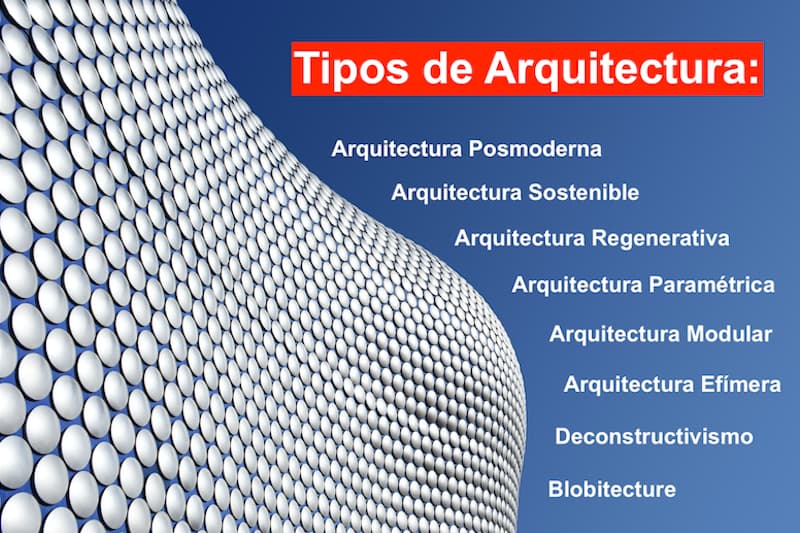
Tipos de Arquitectura: Explorando Más Allá de los Diseños Convencionales

FRASES DE ARQUITECTOS

Roles Arquitectura y Construcción (Profesiones Arquitectura)

Certificaciones para Arquitectos: Avanzando en la Excelencia Profesional

Roles BIM más Demandados en la Industria de la Construcción y el Sector AECO

Software BIM para Proyectos de Arquitectura y Construcción

Tecnología BIM: Beneficios y Ventajas en el sector AECO: Arquitectura, Ingeniería, Construcción y Operaciones

Modelo BIM

Modelo MEP

BIM 3D 4D 5D 6D 7D

AECO: Sector Arquitectura, Ingeniería, Construcción y Operaciones

Avances Tecnológicos en la Industria de la Construcción

Normas Técnicas de Edificación

!Explora el Mejor Directorio de Construcción! 🚧 🏗️ 👷♂️ (Sólo en ArquitecturaCarreras.com)


- CATEGORÍAS DE CURSOS ONLINE
▷ Formación online
▷ Cursos online
▷ Domestika Cursos
▷ Domestika cupón descuento
▷ Cursos de Arquitectura online
▷ Cursos online de Ilustración
▷ Cursos online de Diseño gráfico
▷ Cursos online de Fotografía y Vídeo
▷ Cursos online de 3D y Animación
▷ Cursos de Diseño online
▷ Cursos online de Dibujo
▷ Cursos online de Bellas Artes
▷ Cursos online de Dirección de Arte
- CURSOS ONLINE DOMESTIKA (POR SOFTWARE)
▷ AutoCAD
▷ SketchUp
▷ 3ds Max
▷ Adobe Photoshop
▷ Adobe Illustrator
▷ Adobe After Effects
▷ Adobe Lightroom
▷ Cinema 4D
▷ Adobe Indesign
LOS MEJORES CURSOS ONLINE PARA CREATIVOS | CURSOS DOMESTIKA
- ÚLTIMAS RESEÑAS CURSOS DOMESTIKA
 ▷ Curso Revit Online, por Majo Mora
 ▷ Curso de AutoCAD Online, por Isabel Martínez Abascal
 ▷ Curso SketchUp online, por Alejandro Soriano
 ▷ Curso Infoarquitectura 3D, por Amo Visual 3D
 ▷ Curso de Lumion, por Salva Moret


www.jmhdezhdez.com
(Blog sobre Arquitectura y Arte)
