- Inicio
- Ecosistema AECO
- _ATLAS AECO
- __Mapa Global Obras
- __Serie Const. Vanguardistas
- _Estudios de Arquitectura
- __en Madrid
- __en Barcelona
- _Estudios de Ingeniería
- __en Madrid
- _Estudios de Interiorismo
- __en Madrid
- __en Barcelona
- _Empresas Constructoras
- __en Madrid
- __en Barcelona
- _Empresas de Reformas
- __en Madrid
- _Empresas AECO en España
- __Fabricantes de Materiales
- __Modelado BIM
- __Software BIM
- __ Mediciones y Presupuesto
- __Consultoras BIM
- __Inmobiliarias y Real Estate
- __Investment & Transactions
- __Investment & Capital
- __Const. Industrializada
- __Neoconstrucción
- __Inversión y Des. de Suelo
- __CDE y Gestión Documental
- __Laboratorios AECO
- _Biblioteca Técnica AECO
- __Glosario AECO Global
- __Glosario de Construcción
- __Glosario de Edificación
- __Glosario BIM GTB-300
- __Edificación Circular
- _Entrevistas AECO
- __Jaime Sánchez-Álvarez
- _Visibilidad B2B
- __Premium Multicategoría
- __Ficha Corporativa B2B
- __Partners AECO
- __Patrocinio Directorios AECO
- Arquitectura
- _RASCACIELOS
- __Burj Khalifa Dubai
- __Edificio Chrysler, NY
- _Estilos Arquitectónicos
- __Arquitectura Posmoderna
- __Deconstructivismo
- __Arquitectura High Tech
- Arte
- _Arte Universal
- _Arte Contemporáneo
- __Serge Marshennikov
- __Damian Lechoszest
- __John Kacere
- _Escultura
- __El Ángel del Norte
- __La Musa Dormida
- __Venus de Milo
- __Moisés de Miguel Ángel
- __Baldaquino de San Pedro
- __El rapto de Proserpina
- __La Verdad Velada
- __Perseo con cabeza de Medusa
- __Venus de Willendorf
- _Pintura
- __Capilla Sixtina
- __Cuadros Famosos
- __La Creación de Adán
- __Venus del Espejo Velázquez
- __Hipómenes y Atalanta
- __Venus Boticelli
- __Silla de van Gogh
- __Jugadores de Cartas Cézanne
- __Cabeza de Medusa Caravaggio
- __Impresionismo
- __Posimpresionismo
- _Historia
- __Edad Moderna
- Curiosidades
- _Arquitectura y Arte
- _Tumba de Miguel Ángel
- FRASES
- _Frases de la semana
- _Arquitectos
- __Frank Gehry
- _Escultores
- __Miguel Ángel Buonarroti
- __Bernini
- __Rodin
- _Pintores
- __Picasso
- __Vincent van Gogh
- __Cézanne
- __Claude Monet
- __Henri Matisse
- __René Magritte
- __Caravaggio
- __Miguel Ángel
- Formación AECO
- _Másteres en España
- __Másteres BIM en España
- __Másteres de Arquitectura
- __Másteres de Ingeniería
- __Másteres de Construcción
- __Másteres en Interiorismo
- __Másteres Inmobiliarios
- __Máster Facility Management
- __Másteres de Smart Building
- __Máster Energía y Edificación
- __Máster en Infraestructuras
- __Másteres en Urbanismo
- __M. Project Management
- __M. Construcción Sostenible
- __M. Instalaciones MEP
- _Cursos BIM
- __Cursos BIM Online
- __Cursos Revit Online
- __Cursos Revit MEP online
- _Partner de Formación AECO
- _Formación AECO Empresas
- __en España
- __Capacitación en México
- __en Colombia


Arquitectura, Ingeniería, Construcción y Real Estate; tecnología AECO, metodología BIM, software AEC, modelado BIM, CDE, construcción industrializada, neoconstrucción, fabricantes de materiales y sistemas constructivos; empresas constructoras, promotoras inmobiliarias, fabricantes, proveedores y soluciones para el sector; investigación técnica, Atlas de Arquitectura e Innovación AECO, directorios profesionales y glosarios técnicos; Smart Home, Smart Building, diseño, arte, fotografía arquitectónica, ciudades, edificios, infraestructuras y cultura arquitectónica.
Architecture, Engineering, Construction and Real Estate; AECO technology, BIM methodology, AEC software, BIM modelling, CDE, industrialized construction, advanced construction, building materials manufacturers and construction systems; construction companies, real estate developers, manufacturers, suppliers and solutions for the industry; technical research, Atlas of Architecture and AECO Innovation, professional directories and technical glossaries; Smart Home, Smart Building, design, art, architectural photography, cities, buildings, infrastructure and architectural culture.

Sendai Mediatheque: Toyo Ito’s Fluidity and Liquid Transparency in Japan

Series: Avant-Garde Constructions
Masterpieces of Architecture and Engineering: #21 Sendai Mediatheque, Japan
Is it possible to design a building that functions as a barrier-free, living organism?
The Sendai Mediatheque (1995-2001) is not merely a building; it is the physical manifesto of a structural rupture and the first great spatial operating system of the new millennium. Located facing a tree-lined avenue in Aoba-ku, Japan, this landmark designed by the prestigious Japanese architect Toyo Ito marks the precise moment when architecture abandoned mass to become a fluid interface. Rather than a static container, it operates as a "technological aquarium" where light, air, and programmatic requirements coexist within a continuous field of forces.

Toyo Ito's preliminary sketches for the Sendai Mediatheque: the structural pillars emulate the morphology of seaweed, integrating the engineering with the biological concept of an aquarium.

« It could have happened that, just as Cartesian geometry was first a defining characteristic for Mies van der Rohe and later a limitation, the pursuit of lightness would prevent you from evolving. But it did not completely happen that way for me. Previously, I believed architecture should be fundamentally aesthetic, without fully considering its social meaning. I had the impression that we, as architects, were not integrated into society and had to operate on the fringes. However, in the mid-1990s, I began building in the West and raised the Sendai Mediatheque featuring a free geometry of pillars. I am not an optimist. Yet, that venture into the world made me realize that an architect could indeed contribute to society. I saw that real possibility. » — Toyo Ito


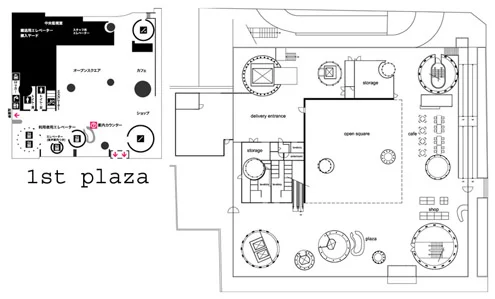
The Sendai Mediatheque articulates four core programs: the Citizen Gallery, the Aoba Municipal Library, the Audiovisual Media Center, and a specialized service hub optimized for sensory-impaired individuals.

Reinventing the Dom-Ino: The Geometry of Uncertainty
Toyo Ito subverts the underlying logic of the Modern Movement. While Le Corbusier's Dom-Ino framework pursued orthogonal standardization, Ito introduces a geometry of uncertainty governed by three structural elements that completely redefine load transfer pathways:

Honeycomb Slabs: Steel-plate structures sandwiched between two solid plates. This structural technique yields extreme visual lightness and allows the tubes to "pierce" through the floor plates without compromising structural integrity, enabling absolute spatial flexibility.
The Chameleon-Like Skin: A double-glazed facade operating as a responsive membrane. On the north and east elevations, the material transitions at each floor level are not decorative; they provide an external reading of the internal programmatic density.
The Tubes (Master Nodes): The disruptive system that obliterates the classical structural grid. By being non-aligned and off-center, they transform the building into a fragment of an infinite structure that expands well beyond its physical boundaries.

Specific structural shafts act as natural ventilation ducts, while others, clad externally in high-performance glass, materialize the concept of "liquid transparency" derived from the aquarium archetype.

The irregularity of the tubes is their greatest asset. Because they are not arranged along a rigid structural grid, the building possesses no single point of failure. Each tubular shaft absorbs seismic energy independently, allowing the structure to 'dance' dynamically rather than resisting to the point of catastrophic structural failure. — Mutsuro Sasaki
Other Issues in the Series:
ISSUE #01 | Burj Khalifa: The Wind Code
Stepping Technique: how geometric variation tames vortices at 828 meters.
ISSUE #02 | CCTV Tower: The Cantilever Challenge
The gravity-defying colossus: precision engineering and a critical dawn connection.
ISSUE #04 | Hearst Tower: The NY Diamond
Structural efficiency: Norman Foster's Diagrid system and steel savings.
ISSUE #07 | Porta Fira Towers: Ruled Geometry
Analyzing Toyo Ito's system: how the repetition of straight elements generates an organic envelope.
Organic Engineering: Tubes as Living Lattices
The 13 tubes form the structural backbone of this thesis. Here, poetics and mechanics merge seamlessly:
Mechanics of Movement: Specific tubes remain open to allow natural air circulation, while others, sealed in glass, materialize that "liquid transparency". This dual nature transforms the tube into a vital organ that breathes and filters light. « To achieve a liquid transparency, we needed extremely thin floor plates. We developed a system of steel plates with internal ribbing (cellular structure) that allowed us to span distances of up to 20 meters with a minimal thickness, enabling the tubes to pierce the floors without the need for downstand beams », — Mutsuro Sasaki

Three-Dimensional Lattice Systems: Although they might resemble arbitrary shapes, the tubes function as complex continuous truss networks. Their geometric irregularity (lozenge profiles and torsions) simultaneously counteracts vertical gravity loads and horizontal wind or seismic forces.
Torsion and Equilibrium: Each irregular tube manages torsional stress independently, allowing the building not just to "stand", but to dynamically balance itself against seismic events.
The 13 tubes are not mere columns in the traditional sense; they are 'bundles' of thin steel pipes that twist and expand. My goal was to create a structure that does not dictate the space, but rather allows the flow of people and air to do so. — Mutsuro Sasaki


The Dissolution of Program: Micro-architecture in Liberty
The collaboration with Kazuyo Sejima, Karim Rashid, and Ross Lovegrove redefines spatial utilization. In a building devoid of walls, the furniture assumes the boundary-defining role under a strict technical premise: the furniture never touches the structural elements.
The program is organized by densities of use, rather than physical partitions.
The Art Gallery utilizes movable panels as a contemporary echo of traditional Japanese spatial flexibility.
The user navigates through the tubes as if moving through an open grove of trees, experiencing absolute continuity between the interior and the exterior tree-lined avenue.
I look to build buildings where people feel comfortable and circulate with total freedom. — Toyo Ito

The Manifesto of the 5 Desires
Ito materialized a technical utopia based on the negation of structural and spatial boundaries:
01
No joints
02
No beams
03
No walls
04
No rooms
05
No architecture
This "non-architecture" is, in reality, a breathing infrastructure. Toyo Ito reconnects with the essence of Gaudí to prove that 21st-century architecture must act as a reflection of life itself, moving past the rigid abstract stoicism of raw concrete.


Industrial Specifications and Solutions
PROJECT PARTNERS| Component | Partner / Brand | Detailed Technical Execution |
|---|---|---|
| Main Contracting & Management | Kumagai Gumi Co., Ltd. | Leadership of the construction Joint Venture, managing civil coordination, on-site logistics, and general execution control of the superstructure. |
| Specialized Building Engineering | Takenaka Corporation | Consortium member responsible for strict quality control and geometric precision during the forming and striking of the horizontal floor plates. |
| Infrastructure & Substructure | Ando Corporation (Ando Hazama) | Technical execution of deep foundations, perimeter retaining walls, and the two basement levels constructed below the water table. |
| Tube Manufacturing & Steel Prefabrication | Miyaji Iron Works Co., Ltd. | Three-dimensional workshop modeling, pre-assembly, and millimeter-precision welding of the unique structural steel sections for the 13 tubular columns. |
| Steel Bending & Naval Technology | Sumitomo Heavy Industries (SHI) | Computer numerical control (CNC) cutting and high-strength cold-bending of structural steel plates to achieve complex organic geometries. |
| High-Strength Steel Supply | Nippon Steel Corporation | Provision of specialized structural steel alloys featuring high seismic ductility for the fabrication of the internal ribbed steel-plate honeycomb slabs. |
| External Envelope & Liquid Transparency | AGC Inc. (Asahi Glass Co.) | Manufacturing of the double-glazed ventilated curtain wall on the south elevation and development of the translucent tempered glass enclosures for the internal structural shafts. |
| Panoramic Elevation Systems | Fujitec Co., Ltd. | Engineering and installation of the fully glazed circular elevators operating continuously within the internal voids of the structural tubes. |
Are you the manufacturer, installer, or technical prescriber for any of these systems?
Request the activation of your partner link by contacting us at:
info@jmhdezhdez.com

Architecture Ceases to Be an Object to Become Behavior
The Sendai Mediatheque is not the conclusion of a path, but the opening of a portal. The RIBA Royal Gold Medal in 2006 recognized the sheer courage of substituting structural statics with a dynamic order. « I came to the realization that architecture must be a permanent force. I utilized lightness and transparency to appeal to the senses, to connect with people. Our duty as architects is to contribute to human happiness. Yet, I now pursue that same objective through a weightier conception of architecture. » — Toyo Ito
In Sendai, Toyo Ito did not design a physical volume; he engineered a living system. Here, the structure does not merely hold load; it orchestrates a continuous field of forces capable of evolving alongside its inhabitants. It is, in its purest sense, architecture understood as absolute liberty.

Sendai was the laboratory where we proved engineering could break away from determinism. We transitioned from traditional Euclidean geometry (cubes and spheres) to an algorithm-driven freeform geometry. — Mutsuro Sasaki
Frequently Asked Questions about Sendai Mediatheque:
How does the structure handle a major earthquake?
The inherent flexibility of the 13 hollow tubes acts as an advanced energy dissipation system. Because it is not a rigid orthogonal frame, the building does not "resist" the impact; rather, it dynamically accommodates it, allowing structural deformations to be distributed in a controlled manner throughout the three-dimensional lattice network.
What does it mean for the building to be a "crossing point"?
It represents the total dissolution of the boundary between public and private space. Both mechanically and socially, the ground floor—known as "The Plaza"—functions as a physical extension of Sendai's sidewalk. There is no heavy transitional threshold, allowing urban flow to penetrate the building uninterrupted.
Why is it defined as a "Hybrid Architecture"?
Because it achieves a perfect synthesis between high-tech industrial steel manufacturing and a purely biological logic. It transcends the dichotomy between the built and the natural environment by utilizing rigid materials to replicate complex organic behaviors, such as the swaying motion of seaweed or the breathing of a living organism.
What is the actual role of the tubes in the building's climate control?
The tubes function as authentic metabolic organs. Specific shafts are engineered to activate natural ventilation via the stack effect, cooling even the basement levels, while others act as lightwells that channel solar radiation down from the roof, minimizing the reliance on artificial mechanical systems.
How is "liquid transparency" achieved through the materials?
It is the result of a subtle interplay of contrasts: Ito combined structural tubes that expose the air with others sealed by glass membranes. When interacting with the double-skin glass facade and shifting reflections, this “liquid transparency” generates a visual depth that suspends users in a fluid medium, akin to being inside an aquarium.
AECO Architecture & Engineering Glossary | Sendai Mediatheque
Steel-Plate Honeycomb Slabs: A horizontal structural system composed of two parallel steel plates enclosing a dense internal grid of welded steel ribs and stiffeners. At the Mediatheque, it replaces traditional reinforced concrete floors; its technical lightweight design drastically reduced dead loads, allowing it to span clear distances of up to 20 meters with minimal thickness and allowing the structural tubes to pierce the floor plates cleanly without downstand beams.
High-Ductility Hybrid Structure: A structural system combining components of distinct material characteristics and geometric typologies, specifically engineered to absorb and dissipate massive inputs of elastic energy without reaching structural collapse. The fusion of the cellular steel-plate slabs with the 13 tridimensional lattice tubes creates exceptional seismic resistance, granting the building the ability to elastically deform and "dance" when subjected to transverse shear waves—a key factor in its survival during the 2011 earthquake.
Structural Steel Tubes (Tridimensional Bundles): Non-linear, freestanding columns formed by a helical framework of circular hollow sections (CHS) that twist, expand, and contract along their vertical path. The 13 tubes serve as the backbone of the complex; their off-center arrangement subverts the classic Le Corbusier Dom-Ino grid, operating simultaneously as load-bearing supports, natural lightwells, building service (MEP) routes, and natural ventilation shafts.
Liquid Transparency / Responsive Membrane: A bioclimatic design concept applied to building envelopes that utilizes active double-glazing systems or ventilated facades to dynamically regulate thermal, luminous, and visual exchanges between the environment and the interior. At the Mediatheque, the south facade consists of a double skin of translucent tempered glass equipped with controlled ventilation mechanisms, generating a "technological aquarium" visual effect while optimizing thermal gains depending on the season.
Geometry of Uncertainty (Non-Linear Design): A structural modeling and calculation approach where the positions, orientations, and profiles of the load-bearing elements do not conform to a uniform or predictable mathematical matrix, thereby distributing mechanical stresses unevenly. This represents a direct subversion of traditional modern movement tenets; the deliberate asymmetry and irregularity of the tubes ensure the building lacks a single critical point of failure under complex seismic demands.
Fluid Programmatic Density: An interior architecture and spatial planning strategy where building functions and programmatic uses are not enclosed by fixed partitions, but virtually and dynamically bounded by user flows and lighting gradients. The programs (library, media center, galleries) coexist in a continuous open floor plan, relying on micro-architectures of freestanding furniture that never anchor to or touch the primary structural elements.
Independent Structural Torsion: The mechanical capacity of an isolated vertical load-bearing element to absorb rotational stresses generated by dynamic lateral forces (such as earthquakes or wind) without transmitting fatigue to the rest of the structure. Each of the 13 tube bundles in the Mediatheque manages its torsion autonomously due to their varying diameters and variable lozenge profiles, optimizing the global dynamic equilibrium of the upper stories.
Freestanding Micro-architecture: Large-scale interior design features that take on the roles of zoning, technical containment, or circulation management within open plans, operating with total structural and geometric independence from the primary architectural container. Organic furniture configurations act as floating partitions, defining service and multimedia inquiry spaces without disrupting the spatial continuity of Toyo Ito's "non-architecture" manifesto.
Series: Avant-Garde Constructions | jmhdezhdez.com
Credits & Documentation
Text & Editing: © José Miguel Hernández Hernández, Author, Technical Editor, and AECO Strategic Consultant
Drawings & Design Concepts: © Toyo Ito & Associates Architects
Images: © Luis Gallardo (LGM Studio)

José Miguel Hernández Hernández
International benchmark in the technical analysis of iconic and sculptural architecture. Specialist in the intersection of engineering, aesthetics, and avant-garde design. Author of the bilingual technical books Turning Torso – Santiago Calatrava and Construcciones Famosas / Famous Constructions.

Publicado por José Miguel


José Miguel Hernández Hernández
Consultor Smart Home y Movilidad Eléctrica AECO
Servicios Destacados
⚡ Consultoría Movilidad Eléctrica
Proyectos CICE e ITC-BT-52.
🎓 Formación BIM / AECO
Especialización técnica avanzada.
📩 Suscripción Nodo Maestro
Innovación y normativa Smart.


Ecosistemas Smart Home por Tipología Guías técnicas y selección de dispositivos para proyectos de arquitectura e interiorismo en Pisos, Lofts, Casas Grandes, Dúplex, Áticos y Villas de Lujo. Integra automatización adaptada a cada espacio.
Ver Guía por Tipologías →
Directorio de Fotógrafos de Arquitectura en España: Descubre a los Mejores Expertos en Fotografía Arquitectónica para Documentar tus Proyectos y Obras

Fotografía Arquitectónica: La Guía Definitiva para Capturar Diseño, Estética y Función de Edificios y Estructuras

Fotografía y Vídeo Timelapse

El Rol del Fotógrafo de Arquitectura

Cámaras Réflex y Objetivos Tilt-Shift para Fotografía de Arquitectura

Estilos Arquitectónicos Modernos: Un Viaje a Través de la Creatividad y la Innovación

ARQUITECTURA CARRERA: Descubre todas las Opciones de la Carrera en Arquitectura y Grados en España

Comparativa de las Mejores Universidades de Arquitectura del Mundo: Internacional, Europa, LATAM

Los Mejores Libros de Arquitectura para Arquitectos

Libros para Estudiar Arquitectura

Libros para Arquitectos Principiantes: Guías y Recursos Esenciales para Comenzar tu Carrera

Los Mejores Libros de Arquitectura para Estudiantes durante la Carrera

Era Digital de la Construcción: Innovaciones Tecnológicas en Arquitectura y Edificación

Comparativa de Los Mejores Ordenadores para Arquitectos en 2024

Las Mejores Laptops para Arquitectura en 2024

Los Mejores Ordenadores de Arquitectura para Estudiantes

Significado de: Términos Clave sobre Arquitectura, Ingeniería y Construcción

Arquitectos: Descubre el Mejor Directorio de Arquitectos que podrás encontrar en Internet (Sólo en AC)
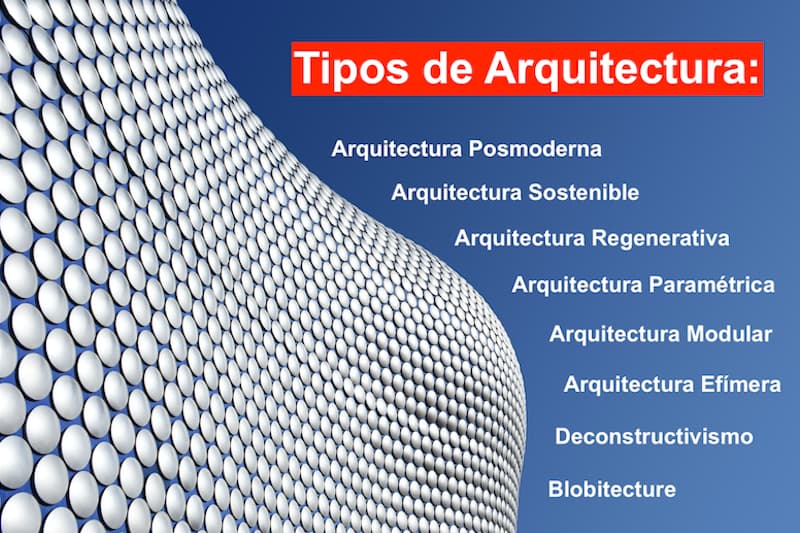
Tipos de Arquitectura: Explorando Más Allá de los Diseños Convencionales

FRASES DE ARQUITECTOS

Roles Arquitectura y Construcción (Profesiones Arquitectura)

Certificaciones para Arquitectos: Avanzando en la Excelencia Profesional

Roles BIM más Demandados en la Industria de la Construcción y el Sector AECO

Software BIM para Proyectos de Arquitectura y Construcción

Tecnología BIM: Beneficios y Ventajas en el sector AECO: Arquitectura, Ingeniería, Construcción y Operaciones

Modelo BIM

Modelo MEP

BIM 3D 4D 5D 6D 7D
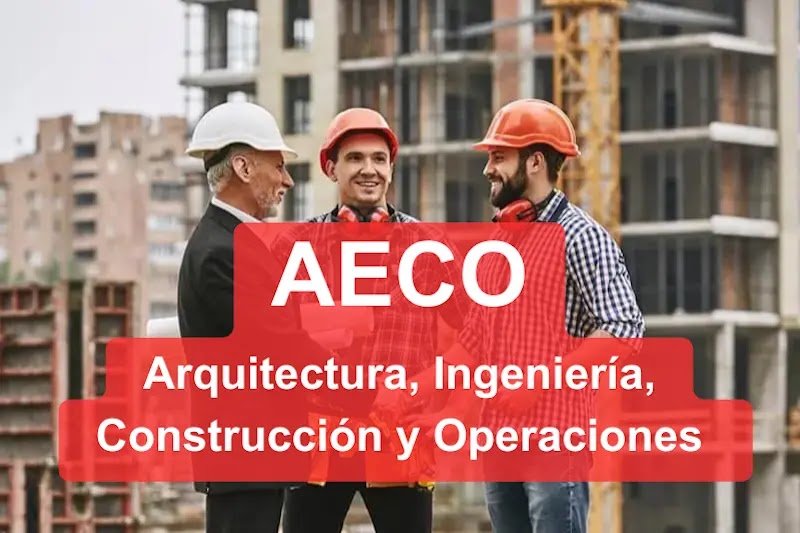
AECO: Sector Arquitectura, Ingeniería, Construcción y Operaciones

Avances Tecnológicos en la Industria de la Construcción

Normas Técnicas de Edificación
!Explora el Mejor Directorio de Construcción! 🚧 🏗️ 👷♂️ (Sólo en ArquitecturaCarreras.com)


www.jmhdezhdez.com
Arquitectura, Ingeniería y Documentación Técnica AECO
